
Choosing accessories rarely starts with a specific product. More often it starts with a problem: devices keep falling, employees have their hands full, equipment has to be put down and searched for all the time. Many companies do not know that such problems can be solved with the right accessories, so they treat them as an unavoidable part of the job.
A good starting point is the working day itself: what the employee does, how much they move and what threatens the device. Based on that, it becomes clear whether protection against damage or comfortable carrying matters more in a given case.
What is the difference between a protective case and a carrying case?
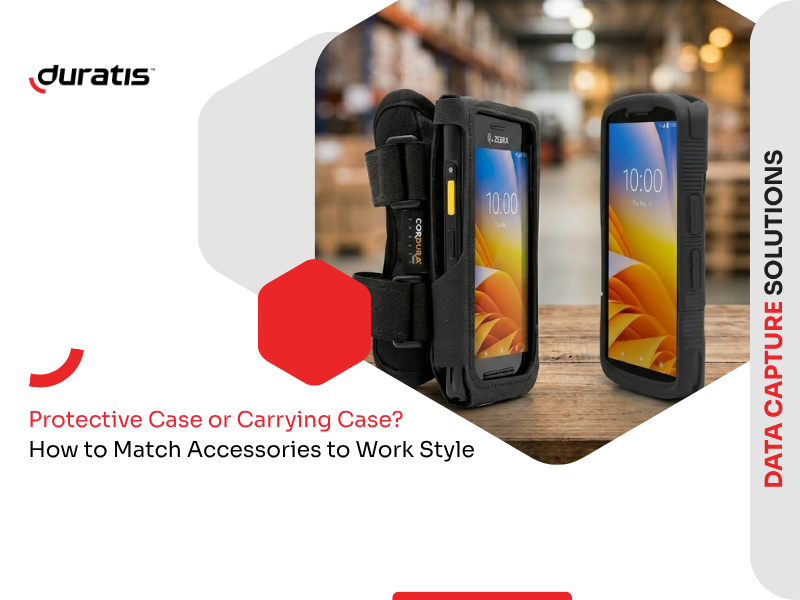
A TPU protective case protects the housing against scratches, abrasion and dust, and also softens the effects of an occasional drop. A textile case is designed for carrying and reduces the risk of dropping or losing the device, because it is attached to the belt, wrist or shoulder. These are two different kinds of protection, chosen according to what threatens the equipment in the customer’s work.
A TPU case is designed for a specific device model and wraps around the housing, protecting it day to day against scratches, abrasion and dust. It also cushions occasional drops and impacts. However, it does not change the way an employee holds or carries the device, so it can still be dropped, or put down and lost.
A textile case, also made for a specific model, is designed primarily for carrying. The device is always with the employee, so it is harder to drop or lose. This is protection through the way of carrying – a textile case does not cover the housing the way a TPU case does.
Not sure which material suits your devices? See our comparison of Duratis case materials.
How can a protective case be combined with a holster or a wrist strap?
A protective case can be complemented with a DURA Holster when the device is to be worn at the belt, or with a wrist strap when the employee holds it in the hand. The customer then gets both protection and a comfortable way of carrying.
A DURA Holster is a universal solution: it fits many device models and comes with an adjustable hip belt. The device in its protective case goes into the holster, so it remains protected during work. As a manufacturer, we recommend this combination where the employee often puts the equipment down or does not move much.
A wrist strap works well when the device is often held in the hand. It provides a secure grip and reduces the risk of dropping it.
What carrying options does a textile case offer?
A textile case comes in several configurations: with Swivel Mount Free, a Rotating Clip, a Still Clip or a shoulder strap. Most cases with an additional mount can also be worn on a shoulder strap, because the case has one or two D-rings.
| Carrying option | How it works | Suitable for |
|---|---|---|
| Schwenkbare Halterung Frei | A connector on the back of the case and a wrist strap in one set. The device is worn on the hand and can be rotated freely. | Small, smartphone-sized devices |
| Rotating Clip | An element on the back of the case and a detachable clip for the hip belt. It rotates 360° with the user’s movements, e.g. when walking, squatting or bending. | Devices of various sizes, including payment terminals |
| Standbild-Clip | A clip integrated into the case, used with a hip belt. | Flat, smartphone-shaped devices |
| Schulterträger | An adjustable strap attached to the D-rings of the case. It can also be used with cases that have another mount. | Most cases, including those for larger devices with a keyboard and pistol grip |
What should complement protective and textile cases?
Both types of case are worth complementing with a screen protector and, for devices with a keyboard, a keyboard film as well. A case covers neither the screen nor the keys. All of these accessories are matched to a specific model.
A screen protector guards the display against scratches and damage, and a keyboard film protects the keys against wear and dirt.
Lesen Sie auch: Wie kann eine Schutzfolie für die Tasten eines Zahlungsterminals Ihre Arbeit erleichtern?
How to recognize customer needs and choose a solution for their industry?
The simplest way is to start with a few questions about how the device is used in practice:
- How large is the device: smartphone-sized, or with a keyboard and pistol grip?
- How much does the employee move during a shift?
- Does the device often fall or come into contact with machines and trolleys?
- Does the employee need free hands?
Retail and hospitality: payment terminals on the move
Employees move between the dining area, tables and the till, and the terminal needs to be always at hand. Wearing it on a belt usually works best, typically with a Rotating Clip, which does not restrict freedom of movement.
Couriers and deliveries: payment terminals on the move
A courier handles cash-on-delivery payments between consecutive parcels, often with their hands full. A terminal worn on a belt with a Rotating Clip stays within reach.
Read also: what else helps couriers and delivery staff work comfortably with a terminal in hand? Find out in this article.
Mobile sales, trade fairs and events: payment terminals away from a fixed checkout
When selling away from a fixed location, there is no counter on which to leave the terminal. Wearing it at the belt gives the device a permanent place and leaves hands free to hand over goods.
Warehouse and production, little movement: protection comes first
Where the employee stays mostly at one workstation and the device often falls or comes into contact with machines, protection comes first. In our experience, a protective case combined with a DURA Holster works well.
Warehouse and production, a lot of walking: mobility comes first
In order picking or stocktaking, freedom of movement and free hands matter. For small, smartphone-sized devices, a textile case with Swivel Mount Free is a good choice. For a computer with a keyboard and pistol grip, a textile case with a shoulder strap is the matching option, because Swivel Mount Free is intended only for small devices.

Zusammenfassung
A protective case and a carrying case answer two different needs: the first protects the housing against scratches, dust and the effects of occasional drops, while the second reduces the risk of dropping and losing the device through comfortable carrying. A protective case can be complemented with a DURA Holster or a wrist strap, and a textile case offers several carrying options matched to the size of the device. Both types of case are worth combining with a screen protector and, for devices with a keyboard, with a keyboard film.
In retail, hospitality and deliveries, wearing the device on a belt with a Rotating Clip usually works best. In warehouses and production, the amount of movement decides: with little movement, protection matters (protective case and DURA Holster); with a lot of movement, mobility does (textile case).
FAQ
What is the difference between a protective case and a textile case?
A TPU protective case protects the housing against scratches, abrasion, dust and the effects of occasional drops. A textile case is designed primarily for carrying: the device is attached to the belt, wrist or shoulder, so it is harder to drop or lose, but the case does not cover the housing the way a TPU case does.
How should a payment terminal be carried when working on the move?
Most often it is worn on a belt, typically with a Rotating Clip that rotates 360° with the user’s movements. This leaves hands free and keeps the terminal within reach.
Which devices is Swivel Mount Free suitable for?
Swivel Mount Free, a mount with a wrist strap, is intended only for small, smartphone-sized devices. Larger devices would be too heavy to wear on the wrist.
How should a mobile computer with a keyboard and pistol grip be carried?
For larger devices, a textile case with a shoulder strap is the matching solution. Swivel Mount Free and Still Clip are intended for smaller, flat devices.

